 Skip-the-line available
 What to See at the Reggia di Venaria Reale
Juvarra's Great Gallery, the Hall of Diana, the Church of Sant'Uberto, the Fountain of the Stag and the Theatre of History route — the must-sees.
The Reggia di Venaria is one of the great Baroque palaces of Europe, and its set-piece interiors come in a deliberate sequence — the permanent route, called the Theatre of History and Magnificence, is a roughly 2,000-metre walk from the ground floor up to the piano nobile, threading the building's masterpieces into a single narrative of the House of Savoy. You move from the 17th-century Hall of Diana into Filippo Juvarra's luminous Great Gallery, on to his Church of Sant'Uberto, then down into the monumental Stables and out toward the gardens and the Fountain of the Stag. Two contemporary layers run through it: a soundtrack by Brian Eno in the Gallery and Peter Greenaway's multimedia 'Peopling the Palaces' installations evoking court life. This guide walks you through the highlights in the order you'll meet them, so you know what to look for and where to slow down.
The Hall of Diana and the Great Gallery
The route opens in the Hall of Diana (Sala di Diana), the imposing 17th-century centrepiece of the original palace designed by Amedeo di Castellamonte. As the ceremonial heart of Castellamonte's hunting residence, it sets the theme that runs through the whole estate — Venaria was built for the chase, and Diana, goddess of the hunt, presides over it. The room's decorative programme makes the palace's founding purpose explicit before you've seen anything else, which is exactly why the permanent display starts here rather than in the grander rooms above. It is also a useful reminder that Venaria predates Juvarra: this is Castellamonte's 17th-century vision, the foundation on which the later Baroque masterpieces were built. From the Hall of Diana the display carries you upward and onward toward the building's single most famous room.
Filippo Juvarra's Great Gallery (Galleria Grande, often called the Gallery of Diana) is Venaria's signature space and the room most visitors come for. Built as part of Juvarra's early-18th-century expansion, it runs as a long, brilliant white corridor lit by 44 arched windows above a black-and-white tiled floor, the light changing along its length through the day. It is routinely compared to Versailles' Hall of Mirrors for scale and ambition. In the permanent display the Gallery is paired with an original ambient soundtrack composed by Brian Eno, which deepens the sense of moving through a vast, luminous void. Take your time here — it photographs beautifully and is the high point of the indoor route.
The Church of Sant'Uberto and Juvarra's Masterpieces
Beyond the Gallery stands the Church of Sant'Uberto (Chiesa di Sant'Uberto), dedicated to Saint Hubert, the patron saint of hunters — another nod to Venaria's origins as a hunting palace. Built by Juvarra between 1716 and 1729, it is one of his Baroque masterpieces: a Greek-cross plan around an octagonal core, crowned with light and rich with sculptural detail. Its solemn, soaring interior is a deliberate contrast to the horizontal sweep of the Great Gallery, trading length for height, and it's one of the clearest demonstrations of Juvarra's command of space and drama anywhere in the estate. Where the Gallery overwhelms by extending the eye outward, Sant'Uberto pulls it upward toward the lantern, so the two rooms read as complementary halves of a single architectural argument about how light shapes Baroque space.
The permanent route also showcases the broader sweep of Juvarra's 18th-century architecture and the sumptuous stucco decoration that fills the piano nobile. Woven through these rooms are Peter Greenaway's multimedia installations, 'Peopling the Palaces', which project evocative scenes of Savoy court life onto the historic spaces — bringing back the people who once filled corridors now walked by visitors. Together the architecture and the installations turn the upper floor from a sequence of empty grand rooms into a staged narrative, which is exactly what the 'Theatre of History and Magnificence' name promises. It is a deliberate curatorial choice that makes Venaria feel less like a museum of objects and more like a re-inhabited palace, and it carries you naturally onward toward the Stables and the gardens beyond.
The Stables, the Bucentaur and the Fountain of the Stag
Juvarra also designed the grand complex of the Royal Stables (the Juvarra Stables), a monumental space that today houses one of the estate's most surprising treasures: the Bucentaur, the ornate royal barge of the House of Savoy. The scale of the Stables — built to house the court's horses and ceremonial vehicles — is a reminder that Venaria functioned as a working royal estate, not just a showpiece, with the practical machinery of court life on the same lavish scale as its state rooms. The surviving Bucentaur is a rare piece of Savoy ceremonial splendour preserved indoors, and seeing a gilded state barge sheltered inside a stable block is one of those incongruities that makes Venaria memorable. The sheer span of the vaulted hall is worth pausing on before you move outside.
Out in the Court of Honour, the Fountain of the Stag (Fontana del Cervo) is the dramatic outdoor counterpart to the interiors. Centred on the hunt theme that defines the whole palace — the stag being the quarry of the chase — it forms part of a water-theatre staging in the great courtyard between the palace blocks and the gardens. It's a natural place to pause as you transition from the indoor route to the grounds, and on event days and during seasonal evening openings the courtyard and its water features become a focal point. From here the gardens open out behind the palace, the next major part of any full visit.
The Citroniera, the Gardens and the Potager Royal
Among Juvarra's outbuildings is the Citroniera, the palace orangery — a vast hall, around 148 metres long, built to overwinter the estate's citrus trees, which were wheeled outdoors in the warm months and stored under glass and stone in the cold. Its sheer length rivals the Great Gallery and makes it one of the most impressive utilitarian spaces in any European palace; today it also serves as a venue for major temporary exhibitions, so what you find inside depends on the season's programme. It is worth checking what's showing before you visit, because a Citroniera exhibition can easily add an hour to your day and is often a highlight in its own right. Even empty, the scale of the hall — built simply to shelter potted lemon trees — tells you everything about the ambitions of the Savoy court.
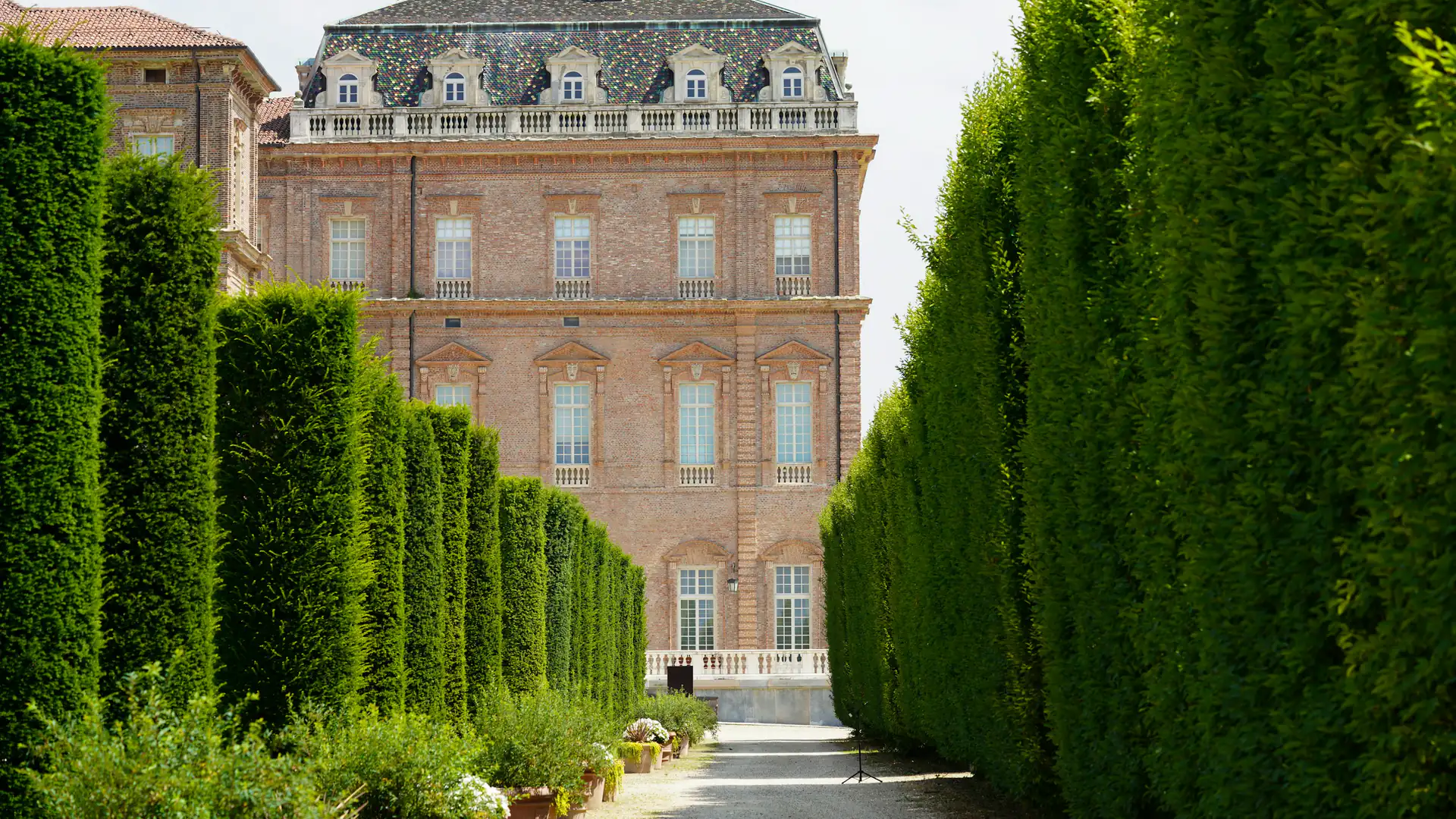
Behind the palace stretch the gardens, covering roughly 60 hectares and ranking among the most spectacular royal gardens in Italy. The Lower Park holds the Potager Royal — the largest royal kitchen garden in Italy — alongside the long Water Canal, the 17th-century grottoes, the remains of Castellamonte's Fountain of Hercules, and Giuseppe Penone's contemporary Garden of Fluid Sculptures, with its bronze trees and fountains spread over three hectares. The sightlines run far into the distance, out toward the forests of La Mandria and, on clear days, the Alpine peaks. Allow real time for the gardens — they are not a postscript to the interiors but half the reason to come.
Frequently asked
What is the must-see room at the Reggia di Venaria?
The Great Gallery (Galleria Grande), Filippo Juvarra's long white colonnade lit by 44 arched windows above a black-and-white tiled floor. It's the palace's signature space, often compared to Versailles' Hall of Mirrors, and is paired with an ambient soundtrack by Brian Eno in the permanent display.
What is the Theatre of History and Magnificence?
It's the Reggia's permanent display — a roughly 2,000-metre route from the ground floor to the piano nobile that links the palace's masterpieces into a narrative of the House of Savoy, taking in the Hall of Diana, the Great Gallery, the Church of Sant'Uberto and Juvarra's grand interiors.
What is the Fountain of the Stag?
The Fontana del Cervo is a dramatic water feature in the Court of Honour between the palace and gardens, themed on the stag and the hunt that gave Venaria its purpose. It forms part of a water-theatre staging and is a focal point on event days and seasonal evening openings.
What is the Citroniera at Venaria?
The Citroniera is Juvarra's monumental palace orangery, around 148 metres long, originally built to store the estate's citrus trees through the cold months. Today it also hosts major temporary exhibitions, so its contents change with the season's programme.
Is the Church of Sant'Uberto worth seeing?
Yes. Built by Juvarra between 1716 and 1729 and dedicated to the patron saint of hunters, it's one of his Baroque masterpieces — a Greek-cross plan on an octagonal core, soaring and richly decorated, and a striking contrast to the horizontal Great Gallery.
What is the Bucentaur on display at Venaria?
The Bucentaur is the ornate ceremonial royal barge of the House of Savoy, preserved and displayed within Juvarra's grand Royal Stables — a rare survival of Savoy court splendour and one of the more unexpected highlights of the indoor route.
How much time do I need to see everything?
Allow about 3.5 to 4 hours for the Reggia and gardens together — the 2,000-metre indoor route plus the 60-hectare gardens. Add a full day if you also want the Citroniera's exhibition and the Castello della Mandria, about 2.5 km away.